
Information Warfare
Tell Stories with Facts. Win with Innovation.
In the modern battlespace, information is everything. We analyze data — big or small — to find the ground truth, whether it's for the courtroom or just for fun. Then we use that truth to win: in grant applications, training programs, and product development.
Origin Story
The Original Information Warriors
Long before modern encryption, the United States military relied on a different kind of unbreakable security: the Native American Code Talkers.
World War I: The Choctaw Telephone Squad
In 1918, during the Meuse-Argonne Offensive, German forces had tapped American telephone lines and broken their English-based codes. One out of every four runners was being captured or killed. Officers overheard Choctaw soldiers speaking their native language and immediately placed them on the field telephones.
Because the language had no direct military translations, they innovated on the fly — artillery became a "big gun", a machine gun became "little gun shoot fast". Within 72 hours, the tide of the battle turned and the Germans were forced into retreat.
World War II: The Navajo Unbreakable Code
The U.S. Marine Corps recruited 29 Navajo men in 1942 to develop a formal cryptographic system. They created a dual-layer encryption: Navajo words mapped to English letters, plus a specialized military dictionary of over 400 terms. A submarine became besh-lo (iron fish). A fighter plane became dah-he-tih-hi (hummingbird).
While encryption machines took up to four hours to process a message, a Code Talker could transmit and decode a three-line message in 20 seconds. During Iwo Jima, six Code Talkers transmitted over 800 messages without a single error. Their code was never broken.
“Were it not for the Navajos, the Marines would never have taken Iwo Jima.”
Why We Carry the Name
They took a language the government had actively tried to eradicate through boarding schools and assimilation policies, and used it to save the free world. That is the ultimate lesson in innovation under pressure. It is also why a core part of our mission is to create remote employment and technology training opportunities for under-served Native American tribal communities.
Data Analytics
Finding the Truth in the Noise
We look at your data and find the truth. For court or for fun. Whether you need forensic data analysis for litigation support, trend analysis for strategic decision-making, or just want to know what your metrics are actually telling you — we parse the signal from the noise.
Our approach combines technical rigor with domain expertise in defense, cybersecurity, and operations. We produce findings that are defensible, reproducible, and written for the audience that matters — not for the analyst who ran the query.
Innovation & Research
Jordan's Innovation Process
There are a lot of ways to create innovation. The key is starting with the Innovator's DNA — five skills that can be practiced and honed to build teams capable of disruptive, not just incremental, breakthroughs.
How do we do it? Remove limits. Reverse conditions. Write science fiction. All while being comfortable and having fun.
See the Full Process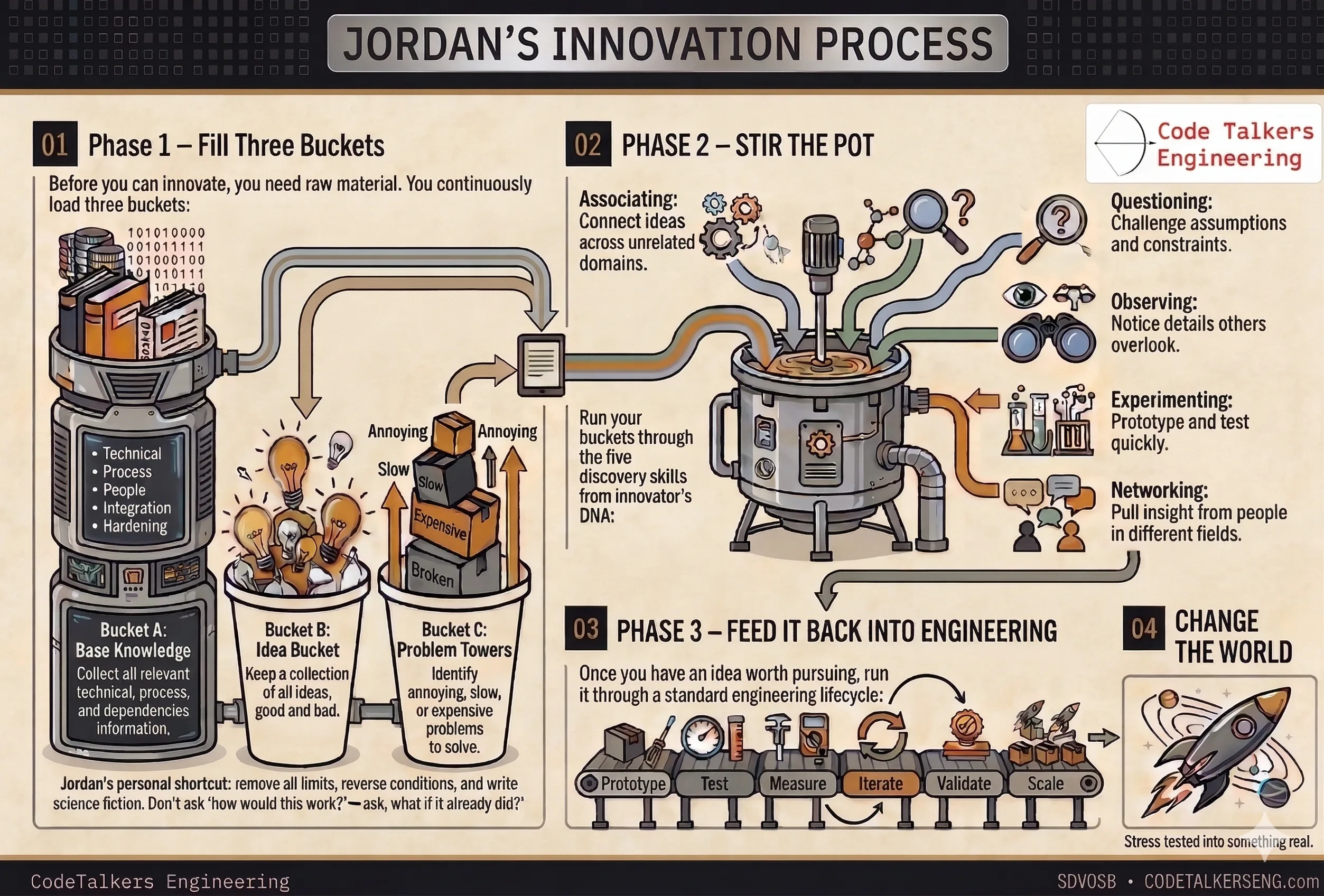
Training & Education
Gamifying Education to Drive Motivation
Adults learn best when they don't feel like they're learning. We turn complex technical training material into game mechanics — forcing players to think the way an attacker thinks, a defender defends, and an analyst analyzes.
The result is faster knowledge retention, higher training completion rates, and teams that actually remember what they learned six months later when an incident happens.